Showing posts with label were-creature. Show all posts

Saturday, January 10, 2026

Wolf Man vs. Dracula

The specious enmity between vampires and werewolves has been explained in various places (e.g., Maverick-Werewolf), so I won't go into it other than to say that it seems like another instance of stan culture spreading into mainstream belief.

Many people say that the rivalry was popularized by the film Underworld, but it has been present in film since the days of the classic Universal Pictures monster movies. A Wolf Man vs. Dracula film was even proposed, but never came to fruition (though elements seem to have been incorporated in the House of Dracula).

Creepy #7 Feb 1966
Cover by Frank Frazetta

To go along with this theme, there are two new sets from Dark Alliance that bring us figures of vampires and werewolves.

The Vampires set consists of 48 figures in 12 poses.


The figures include Vlad Tepes, three classic Dracula-style vampires, and a very elusive Orlok-style nosferatu.


I am particularly fond of the nosferatu, but I felt some of the other face sculpts were a bit lacking. It would have been nice if they could have made more variation by perhaps replacing one of the caped Dracula vampires with the version from the Francis Ford Coppola Dracula film.

Bram Stoker's Dracula, 1992

The next group of figures are of three vampire brides, and a prospective vampire bride (I think).


The third vampire bride figure from the left looks like she may have been modeled after Marishka from the Van Helsing movie.

Marishka

The final group of figures are what I assume are lesser vampires, though the first figure from the left may be a human servant of some sort, while the third may be another nosferatu.


The figures can also double as zombies, given their poses and the torn clothing(?) on the two figures to the right.

The WereWolfes [sic] set consists of 40 figures in 10 poses.


The first two figures are Gabriel Van Helsing and Anna Valerious from the 2004 film Van Helsing. The third figure looks like a classic Lon Chaney-style Wolf Man.


The sculpts are good representations of the characters, though I don't think Kate Beckinsale really has legs that long.

Kate Beckinsale in Hollywood with Dolls Kill
Extreme Appetite for Destruction Platform Boots

The next group of figures are human sized werewolves.


The bases on these figures (and many of the others) were all warped for some reason. For expediency, I just shaved the bases to allow the figures to stand, but I'll have to fix them to be more level later on.

The final set of figures include a couple of giant werewolves, and two crouching werewolves.


Overall, both sets are quite nice, though I have to admit that I now have more vampires and werewolves than I know what to do with. However, if you still are looking for other vampire and werewolf figures, see my post from 2009.

Saturday, December 17, 2022

The House of Ananse

Ananse is a folk hero and trickster figure from Akan mythology. He is also considered the god (abosom) of stories and wisdom due to events related in the story Anansi and the Pot of Wisdom.

Adinkra for "spider web"
(ananse ntentan)

Ananse is variously described as a spider, an anthropomorphic spider, or a human with spider-like characteristics. In stories like How Anansi Became a Spider, he is transformed from a man into a spider (most scholarly sources claim that the transformation was performed by Nyame, but I have yet to read an actual story that relates this episode). Other tales such as Why Anansi Has Eight Thin Legs, Why Anansi Has a Narrow Waist, or Why Anansi Has a Bald Head tell how he came to acquire his spider-like characteristics.

Ȯkyeamepoma from the
Metropolitan Museum of Art

Given the malleability of his shape, it's no wonder that Ananse is often used as a source of inspiration for werespiders. The comic book Is'nana the Were-Spider by Greg Anderson Elysée tells the story of one of his sons.

Vol 1: Forgotten Stories

Meanwhile, in RPGs, werespiders inspired by Ananse include the Ananasi from the World of Darkness setting by White Wolf, and the Anadi from the Mwangi Expanse setting for Pathfinder.

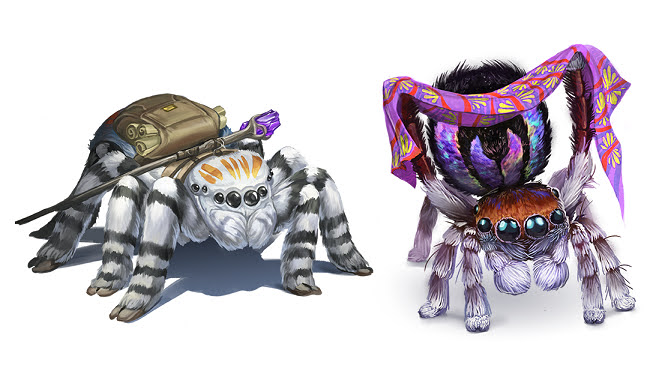
I have two miniatures of Anadi in their spider form from the Pathfinder Battle line. On the left is an Anadi Elder (The Mwangi Expanse #2), and on the right is an Anadi (The Mwangi Expanse #15).


Both figures are modeled after official art, with the Anadi Elder seemingly based on some sort of huntsman spider, while the Anadi looks like it was based on a peacock spider (which actually isn't found in Africa as far as I know).


There is also a miniature of an Anadi in hybrid form (humanoid with spider head) from the Mwangi Expanse set, but it was much too tall to be useful for me.


It's not clear how the hybrid forms of Ananse were originally envisaged in Africa, and I can't seem to find modern drawings of Ananse that originate from Africa, but I did take a liking to the following images I found on the Interweb.

Unknown source and artist

From Annancy Stories
by Pamela Colman Smith

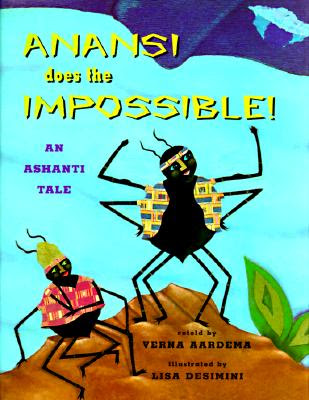
Story: Verna Aardema
Art: Lisa Desimini

From Anansi the Spider
by Gerald McDermott

African Folklore Series: Film One


Monday, August 10, 2020

Chalawan


Chalawan (ชาละวัน) is a crocodile spirit from the Thai folktale Kraithong (ไกรทอง). The story was adapted into a lakhon nok play credited to King Rama II, and has received a number of film adaptations over the years.


The story is so popular, that there is even a Thai craft beer named after Chalawan.

Anyone think their logo looks familiar?

In the story, Chalawan lives in a cave containing a magical crystal that gives all the crocodiles within human form. Outside of the cave however, he appears as an enormous crocodile. On occasion, Chalawan is also depicted as being half-man, half-crocodile.


A Cambodian take on the story can be seen in the film Kropeu Charavan (ក្រពើឆារ៉ាវ៉ាន់) aka The Crocodile Men. In this film, Chalawan (Charavan) is fully human, but knows a spell to transform into a crocodile.


The spell is very reminiscent of legends about the Indonesian power of tiang maleh rupa that allows people to change into crocodiles, or crocodiles to change into humans. And in fact, these legends are often credited as being the source for werecrocodiles in RPGs. In the Indonesian horror movies based on these legends, these creatures always seem to be albino crocodiles (buaya putih).


For more inspiration on magical crocodiles, I turned to the first issue of the zine A Thousand Thousand Islands, by Zedeck Siew, with art by Mun Kao.


MR-KR-GR describes a land of crocodiles and their human subjects. The zine introduces us to the Place of Crocodiles, but does not delve deeply into detail so I'm not sure I can characterize it as a gazetteer. The setting is painted with broad strokes, yet is evocative and tantalizes the reader with bits and pieces of the wondrous and grotesque.


Zedeck doesn't have any plans to make a comprehensive guide for his setting since he prefers the open-ended feel of the different locales introduced in his zines, but I personally would want to do a lot of research into the culture and mythology of Southeast Asia to do justice to the setting. Nevertheless, there are many people who can take off running with it just fine, so it is certainly not a hindrance to not have any sort of detailed background.

I'm not sure if there is currently any stock of the latest printings of the zine, but you can always contact Zedeck to check on availability.


Anyway, on to miniatures. There are several companies that make crocodile-men, including Privateer Press (Gatormen) and Crocodile Games (Sebeki), but the only series of miniatures that are close in size to 1/72 scale figures are the old C19 and RR11 Lizardmen from Citadel.


Grenadier also made the Caroc (Monster Manuscript Vol.II 1502, MM10) which I think matches well with the Citadel miniatures.


For regular crocodiles there are a lot of different plastic toys that can be used, but most of them are probably too large for use with 1/72 scale figures.

I only have the Airfix crocodile from the Tarzan figure set (01733), while all my other figures are actually alligators. The adult and baby alligators are from the Airfix Zoo Animals No. 1 set (01724). Next is a Galoob alligator from the National Geographic Collection Swamp Adventure set, and at the end is the Marx alligator from the Noah's Ark playset.


Last but not least is the D&D Icons of the Realms Crocodile (Waterdeep Dragon Heist #30), which can be used as a large saltwater crocodile.


Saturday, February 23, 2019

Curse of the Werewhale

Despite how preposterous they seem (or perhaps because of it), werewhales enjoy quite a bit of popularity in fiction, art, and even heavy metal music.

The graphic novel The Curse of the Werewhale from Artgasm Studios includes four stories about werewhales. I particularly like Gugliotti's artwork for the story Arriuk Auminal.

Cover art by Chris Gugliotti

Werewhales also are mentioned in the Wereworld series of YA novels by Curtis Jobling.


Pop culture aside, these creatures also exist in real-world mythology. The self-proclaimed world expert on "whale-ish lycanthropy" is Lyonel Perabo, who's master's thesis about pre-modern Fennoscandian literature (available as a pdf from Skemman) includes a section on Sámi werewhales.

The creatures mentioned in the thesis are typical of real-world mythological were-creatures, in that they take on a full animal appearance, as opposed to the typical modern depiction of a creature that is halfway between man and beast.

I don't think that there are any miniatures of werewhales being made at this time, but WizKids produces the HeroClix Giganto (Avengers Infinity #G007), which would be a great representation of a modern-style werewhale.


This version of Giganto is green, which seems a bit odd for a whale, but perhaps it is a relative of the troll werewhale that is mentioned in Perabo's thesis.


The figure stands at a bit over 3½" tall, which would be over 21' tall in 1/72 scale. This would be approximately the size of the Giganto that appeared in Fantastic Four #149 as opposed to the much larger original beast from Fantastic Four #4 (who was killed with a nuclear bomb).

Take that comrade!

I haven't been writing much lately because the cold weather this last couple of months has put me into a state of hibernation. However, I plan to start posting more regularly again when the temperature starts to warm up around here.


Saturday, December 22, 2018

Joulupukki

Last year, Finland inducted Joulupukki (aka Santa Claus) to their National Inventory of Living Heritage. The modern Joulupukki looks pretty much like the version of Santa Claus popularized by the advertising paintings produced for Coca Cola by Haddon Sundblom.

Joulupukki and his tontut.

However, there was a time when Joulupukki bore the literal appearance of his name—Yule Goat, and was said to have been an actual goat, or some kind of weregoat.


The concept of [were]goats bearing gifts is said to have come from the merging of Joulupukki with Nuuttipukki. Nuuttipukkit were Krampus-like figures who would make the rounds at the end of the Yuletide festivities. Some say they represent spirits to be appeased, while others say they drive off spirits who would otherwise overstay their welcome during the Yule.

Anyway, the Yule Goat is an appropriate subject for this time of year, but the post is really about weregoats (of which the Yule Goat is the closest thing in mythology that I could find).

There is only one weregoat figure that I am aware of. It comes from the Judges Guild City State Miniatures line. I'm not sure if there are any stats for this creature in any of the Judges Guild publications, but current homebrew D&D stats found on the internet seem to treat weregoats no differently from satyrs.

The Judges Guild weregoat happens to be one of my grail miniatures, but unfortunately Eisenwerk miniatures are near impossible to find. Thus I decided to make do with a proxy from the Ganesha Games Miniatures line produced by Alternative Armies.


This particular miniature is the mount from the Skeleton Undead Ram Rider (Hammer and Forge UDD007).


The creature is supposed to be a ram and not a goat, but the face is rather bovine, so it doesn't really look like either. I'll probably modify the horns to point backwards so that it is more goat-like, but I'm not sure there is too much else I can do about the head.