Showing posts with label grenadier. Show all posts

Monday, August 10, 2020

Chalawan


Chalawan (ชาละวัน) is a crocodile spirit from the Thai folktale Kraithong (ไกรทอง). The story was adapted into a lakhon nok play credited to King Rama II, and has received a number of film adaptations over the years.


The story is so popular, that there is even a Thai craft beer named after Chalawan.

Anyone think their logo looks familiar?

In the story, Chalawan lives in a cave containing a magical crystal that gives all the crocodiles within human form. Outside of the cave however, he appears as an enormous crocodile. On occasion, Chalawan is also depicted as being half-man, half-crocodile.


A Cambodian take on the story can be seen in the film Kropeu Charavan (ក្រពើឆារ៉ាវ៉ាន់) aka The Crocodile Men. In this film, Chalawan (Charavan) is fully human, but knows a spell to transform into a crocodile.


The spell is very reminiscent of legends about the Indonesian power of tiang maleh rupa that allows people to change into crocodiles, or crocodiles to change into humans. And in fact, these legends are often credited as being the source for werecrocodiles in RPGs. In the Indonesian horror movies based on these legends, these creatures always seem to be albino crocodiles (buaya putih).


For more inspiration on magical crocodiles, I turned to the first issue of the zine A Thousand Thousand Islands, by Zedeck Siew, with art by Mun Kao.


MR-KR-GR describes a land of crocodiles and their human subjects. The zine introduces us to the Place of Crocodiles, but does not delve deeply into detail so I'm not sure I can characterize it as a gazetteer. The setting is painted with broad strokes, yet is evocative and tantalizes the reader with bits and pieces of the wondrous and grotesque.


Zedeck doesn't have any plans to make a comprehensive guide for his setting since he prefers the open-ended feel of the different locales introduced in his zines, but I personally would want to do a lot of research into the culture and mythology of Southeast Asia to do justice to the setting. Nevertheless, there are many people who can take off running with it just fine, so it is certainly not a hindrance to not have any sort of detailed background.

I'm not sure if there is currently any stock of the latest printings of the zine, but you can always contact Zedeck to check on availability.


Anyway, on to miniatures. There are several companies that make crocodile-men, including Privateer Press (Gatormen) and Crocodile Games (Sebeki), but the only series of miniatures that are close in size to 1/72 scale figures are the old C19 and RR11 Lizardmen from Citadel.


Grenadier also made the Caroc (Monster Manuscript Vol.II 1502, MM10) which I think matches well with the Citadel miniatures.


For regular crocodiles there are a lot of different plastic toys that can be used, but most of them are probably too large for use with 1/72 scale figures.

I only have the Airfix crocodile from the Tarzan figure set (01733), while all my other figures are actually alligators. The adult and baby alligators are from the Airfix Zoo Animals No. 1 set (01724). Next is a Galoob alligator from the National Geographic Collection Swamp Adventure set, and at the end is the Marx alligator from the Noah's Ark playset.


Last but not least is the D&D Icons of the Realms Crocodile (Waterdeep Dragon Heist #30), which can be used as a large saltwater crocodile.


Saturday, June 20, 2020

Ochre Jellies and Vargouilles


The ochre jelly is a monster from D&D that is based on the amoeba. Its special ability is that it splits into multiple monsters when struck with lightning spells or weapons.


I have two metal miniatures of this creature from Grenadier. The jelly on the left is from the Monsters large boxed set (Advanced Dungeons & Dragons 5002), and the one on the right is from one of the Monster Manuscript boxed sets (Monster Manuscript Vol.VII 1507, MM59).


They're essentially something that anyone with a hot glue gun or blob of clay can make nowadays, but the early Grenadier slimes are quite interesting because they were sculpted with eyes.

悪いスライムじゃないよ!

I actually made a press mold of this particular miniature at one time with the intention of using the Dark Art to cast up a modified miniature in clear resin. I planned to use small clear beads mixed in the resin as vacuoles and organelles, a larger colored bead as the nucleus (or eye), and bits of treasure or bone as excretory crystals.


I never got around to make the cast, but if I ever find that mold again I will definitely finish that project.

The most recent depictions of ochre jellies show them with writhing pseudopods that they use to bludgeon prey. The Pathfinder Battles Ochre Jelly (Dungeons Deep #028) is typical of this representation.


I find the idea of an ochre jelly fighting with flailing pseudopods rather unfitting, and offer an alternative method of attack. I envision small ochre jellies trying to envelop the heads of victims to suffocate them like the slimes from Dungeon Meshi.


Large ochre jellies on the other hand, rear up and then collapse on top of their prey to engulf them like real amoebas do.


I actually like the D&D Miniatures Living Spell Cloud Kill (Eberron: Rising from the Last War #029) as an ochre jelly proxy because it looks like it is about to rise up and come crashing down on its victim.


The next monster I'll cover is the vargouille. It first appeared in the AD&D Monster Manual II, where its bite resulted in the permanent loss of hit points. In later editions it seems that the vargouille gained the ability to kiss its victims and transform their heads into new vargouilles that would then separate from the body and fly off.

Is it possible to kiss without an upper lip?

The vargouille seems to be based on the chonchon or tue-tue from the mythology of the Mapuche people of Araucanía and Patagonia. It is also a monster used in both RuneQuest and Castlevania.

The chonchon is the transformed head of a kalku, who appears as a normal human by day. At night, the chonchon separates itself from its body to go about its nocturnal activities.

Chon Chon by Ed Kwong

It is often said to be invisible to normal human eyes, and its cry is supposed to bring misfortune to those who hear it.

El chon chón de Limón Camilo

The chonchon also reminds me a lot of the harpy from the Daijiro Morohoshi story Adam's Rib (アダムの肋骨).


I bought a couple of Vargouille miniatures from the D&D Icons of the Realms line because they were really cheap. There are two variants that differ based on the color of their hair. On the left is the black haired version (Waterdeep Dragon Heist #03), and on the right is the brown haired version (Waterdeep Dragon Heist #14).


An even cheaper option is to make them on your own as described over at HotT in the Lower Hunter. I may create some with talons and wings like actual chonchons in the future.


Sunday, March 29, 2020

Magic Mouth

I don't believe that it was ever explicitly stated, but I think that everyone understood that this iconic Trampier illustration was of a magic mouth.


I had some left over Kneadatite that I was using to fill some gaps in a minature, so I decided to put it to good use by trying to replicate the magic mouth from the picture.


I'm mostly happy with how it came out, but I'll probably do a bit of sanding to adjust some of the contours around the mouth.

I also need to figure out how I want to model the vaulted arches of the passageway without making things overly complicated.

As far as commercial miniatures go, there are two that I am aware of.

The first is the Citadel Magic Mouth Doorway (Fantasy Specials 2).


I stripped the old paint off of this model a long time ago, but never got around to re-paint it.

The other is the Grenadier Talking Door from the Dungeon Items set (Wizards & Warriors SS04).


This piece is pretty hard to find, but you do see it every now and again.


Saturday, March 14, 2020

Dracolisks


The original dracolisk from AD&D module S4 The Lost Caverns of Tsojcanth was specifically described as a cross between a black dragon and a basilisk.

I think that it wasn't until 4th edition, that the description of dracolisks expanded to include variants with parentage from other types of chromatic dragons.

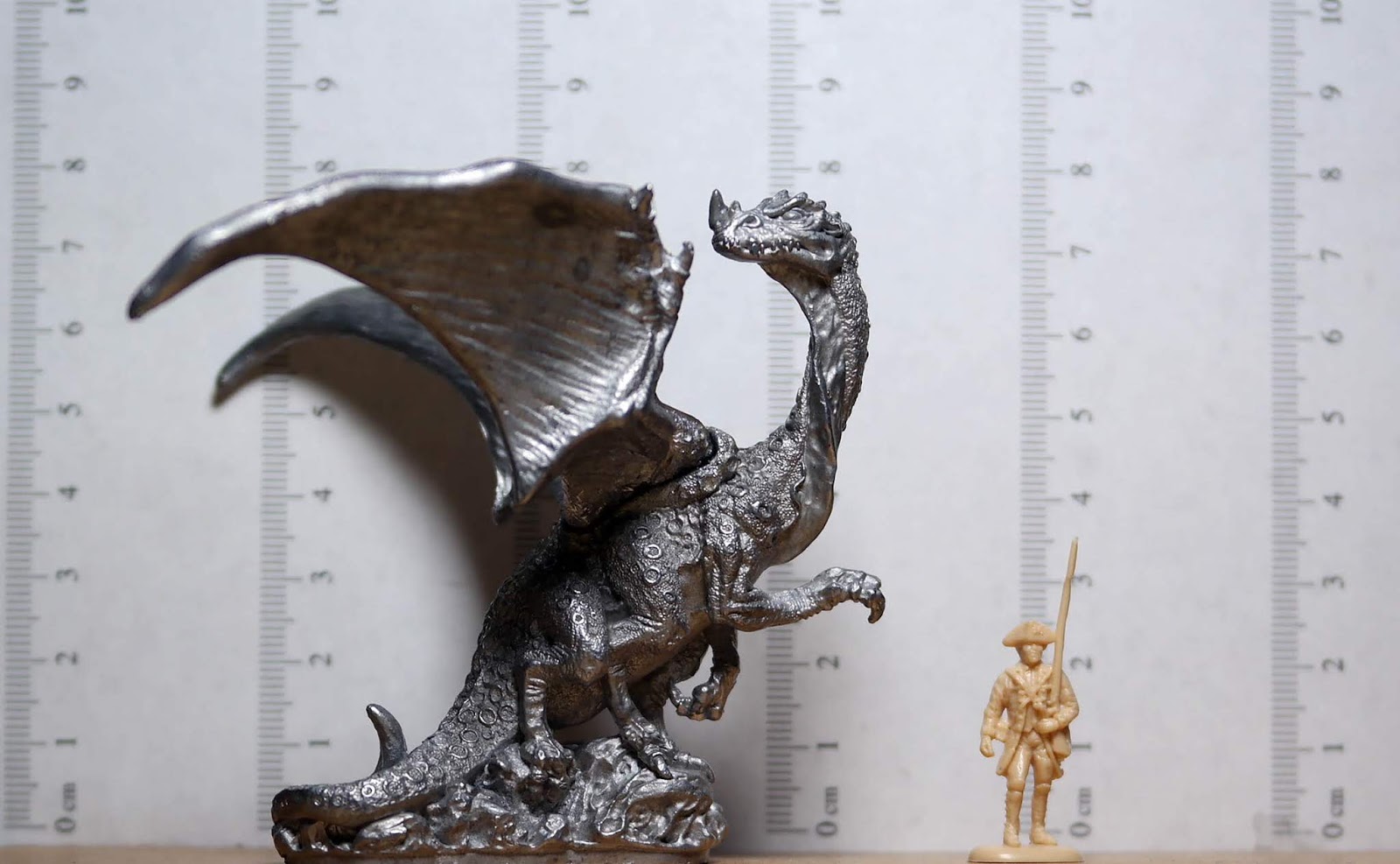
I own three different miniatures of the dracolisk.

The old Grenadier Dragonlisk (Dragon Lords 2514) is my favorite, because it looks closest to the Jeff Easley illustration from the module.


The body of the dragonlisk is not very thick, so if you pin the wings when assembling the model, just remember to stagger the pins so that they don't intersect each other when you glue both wings to the body.

The Pathfinder Battles Dracolisk (Dungeons Deep #16) has a nice flying pose, but is rather small, and would probably look better with 15mm miniatures.


It has four pairs of legs instead of the stated three, some of which are posed rather awkwardly.

Last, is the Reaper Dracolisk (Bones 77379), which I painted up as a dracolisk with white dragon parentage.


I cut away part of the base so that both front legs look like they are raised (I saw someone do this for their model, and thought it looked pretty good).

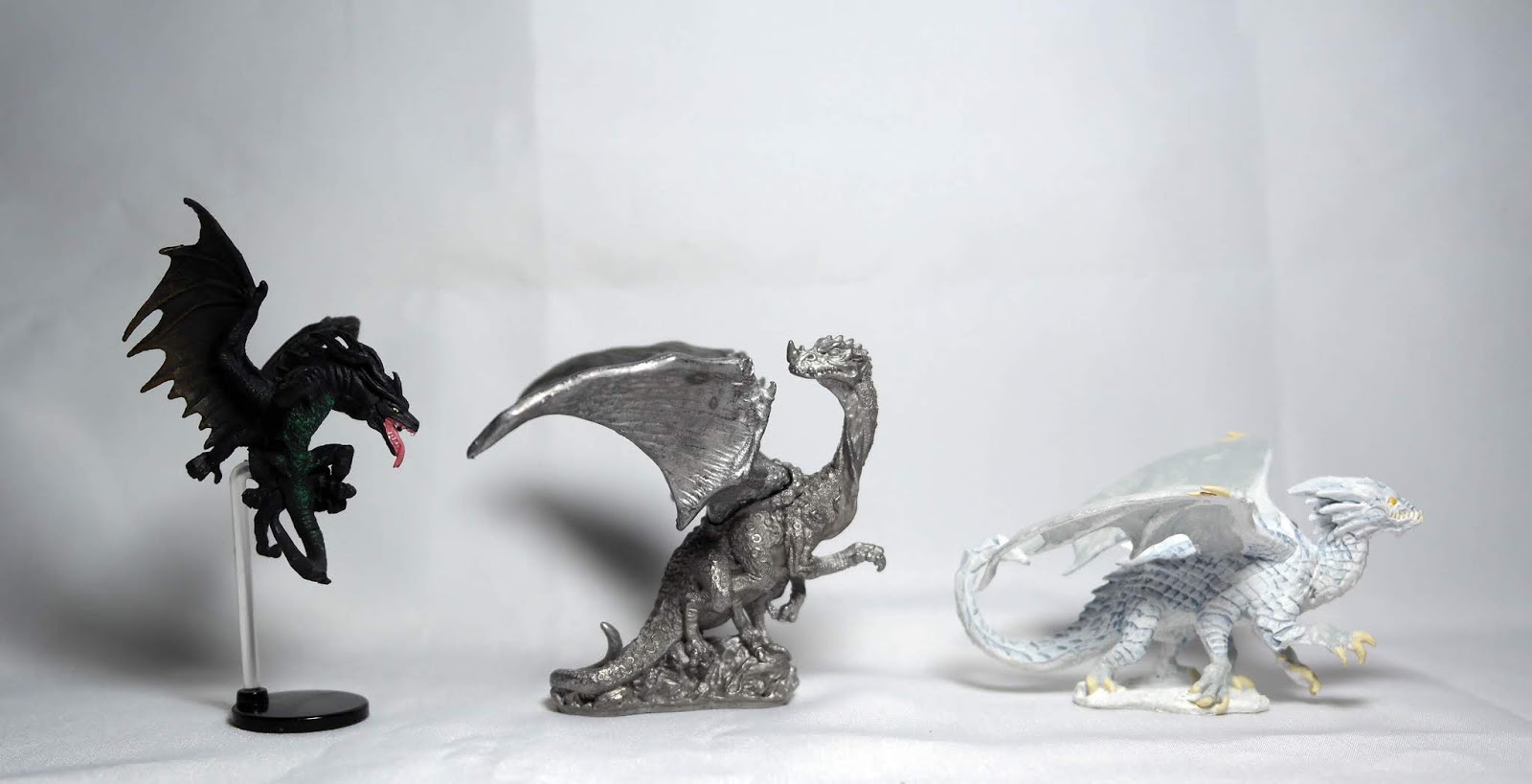
Some shots of the dracolisks all together.


Friday, May 3, 2019

Ogre Magi


The ogre mage or Japanese ogre of D&D is essentially an oni (which I guess has been the official designation since 4th edition).

Fuji Musume + Oni no Nenbutsu
by Kitagawa Utamaro

The typical oni that an adventurer might meet would be something like the ogre or giant of European mythology, but oni are also servitors in the Buddhist hells, and in this role bear many similarities to Abrahamic devils.


In art, they are portrayed anywhere from being slightly larger than a human to being gigantic in size. Most miniatures will tend to be of the later type when used with 1/72 scale figures.

I will start by showing some of the shokugan/gashapon figures that I own. The standing pair are from series 1 of the Collect Club Seven Wonders Compilation (コレクト倶楽部 七不思議編) released by UHA Mikakuto (UHA味覚糖), and are a red oni (赤鬼) and blue oni (青鬼) respectively. The crouching figure is the red (赤) version of a yōkai netsuke (妖怪根付) from the Hyakki Yagyō Yōkai Collection (百鬼夜行妖怪コレクション) released by Furuta (フルタ).


The series 1 UHA figures are single piece castings made of a dense polystone resin. The Furuta figure is made of PVC, and a painted version is also available.

       鬼 (赤)       |       鬼 (天然色)  

The subsequent series 2 figures from UHA are a black oni (黒鬼) and a green oni (緑鬼) respectively.


The series 2 figures are multi-part PVC, and require some assembly.


The next figures come from the Rising Sun boardgame produduced by CMON. They include the Oni of Plagues, a Turtle Clan Shinto, and two Turtle Clan Bushi.


I'm not enthusiastic about the fancifully ornate weapons of the Oni of Plagues, but I liked the figure because it reminded me of Tsuchigumo from Nurarihyon no Mago. As for the Turtle Clan miniatures, I don't think they are actually supposed to be oni, but they are horned and fanged, so look close enough to be oni for me.

I particularly like that the monk on the Shinto figure is close in size to the similarly posed figure from the Arcane Legions game. However, I find the use of the term "shinto" for this class of characters by the game writers odd, and I'm thinking the word they should have used would be kannushi (but what do I know).


In the next image, we have the Oni of Blood which is also from the Rising Sun game, while next to it is a DDM Oni Night Haunter (Lords of Madness #35).


The Oni of Blood is a very elaborate sculpt, and I'd be really interested in seeing the production mold for it because it seems to have been made as a single piece.

I did a quick earthen wash over the pants of the Oni Night Haunter because I didn't like the original bright yellow color. The base was also replaced with a metal washer because it was so warped that I could not flatten it out using either hot water or a blow dryer.


The next two figures are the D&D Miniatures Icons of the Realms Ogre Mage (Classic Creatures #5), and a Reaper Female Oni (Bones 77486).


I like this CMG ogre mage because it has a single horn, which is sorely underrepresented in miniature oni. The turquoise and magenta skin of these two oni go well together, and are a nice variation on the traditional blue and red oni.

The next section covers all of my metal oni. The first three miniatures are a Ral Partha Ogre Mage (AD&D Monsters 11-405), a Ral Partha Dai-Oni (Bushido 53-912), and a Ral Partha Japanese Ogre (Children of the Night 13-039).


The last two figures are supposed to be armed with naginata, but I seem to have lost the weapons at some point.

The next image has an armed pair of Ral Partha Oni (Bushido 53-908), a Ral Partha Dai-Bakemono (Bushido 53-911), and an Asgard Oriental Ogre (Fantasy Monsters FM22).


The dai-bakemono is supposed to have a large tetsubo, but again, I seem to have lost the weapon. The Asgard miniature is the earlier version of their oriental ogre. It was probably originally holding some sort of weapon, but I'm not sure what type it was (the later resculpted version of this miniature carries a large two-handed mace).

The next image shows some old Reaper miniatures. The larger figure is a Bakemono (Daimyo 4027), while the three smaller ones are Oni (Daimyo 4028). The Daimyo Oni are sized like 15mm figures, and I get the feeling that they were originally supposed to be "oriental goblins". Certainly when these miniatures were first released by Texas Miniatures, they seem to have all been called bakemono, so they didn't start out as oni.


In any event, I'm grouping all the creatures called bakemono with oni because they look close enough going by looks alone. My understanding of the word "bakemono" is that it is a generic term like "monster", so using the word to indicate a specific type of creature is vague and confusing (I blame the Bushido RPG for this).

Along those lines, I'm counting the Grenadier Oriental Goblins (Fantasy Lords 184) shown in the next image among my ranks of oni.


Even so, these goblins don't have features that are particularly oni-like, and wear their hair in a chonmage, so I'll probably need to do a little modification to turn them into proper oni.

In the Legend of the Five Rings RPG, it seems that oni are called ogres, while demons are called oni. This is reflected in the AEG Clan War miniatures, with the Ogre Bushi (Shadowlands 13-103) looking like an oni, and the oni lord Kyoso no Oni (Shadowlands 99-002) looking like a demon.


The Lesser Oni (Shadowlands 13-113) are also very demonic, and look nothing like traditional oni at all. In fact, I would probably classify them as generic bakemono.


The final section covers 15mm oni from Alternative Armies, and Battle Valor Games.

The Alternative Armies figures are part of their Sengoku Japanese Fantasy line. In the first image (from left to right) – Oni with Claws (SGF04), Oni with Large Blade (SGF05), Oni with Large Blade (SGF06), Armoured Oni with Large Blade (SGF85), Armoured Oni with Claws (SGF86).


More Alternative Armies figures (from left to right) – Oni with Claws (SGF87), Oni Shamen [sic] (SGF88), Oni with Tetsubo (SGF89), Oni with Tetsubo Beckoning (SGF90)


The armored oni are human-sized, while the unarmored oni are shorter. I wish the unarmored oni had been made the same height as the armored ones.

The Battle Valor oni are figures from the Samurai fantasy skirmish Kickstarter by Philip Mann. I pledged at the Oni Lord level to get an Oni Army Set.

The first image is of the Oni Command (SAM126).


Next are the Dai Oni (SAM127).


Then the Oni (SAM128).


Last are the Small Oni (SAM129).


There are a lot of similar poses between the oni and dai oni, but the later are more suitable as 1/72 oni. I don't see the oni on the Battle Valor website at this time, but I imagine they will appear at some point in the future. Hopefully the Dai Oni Command set which was not unlocked during the Kickstarter campaign will be produced as well.

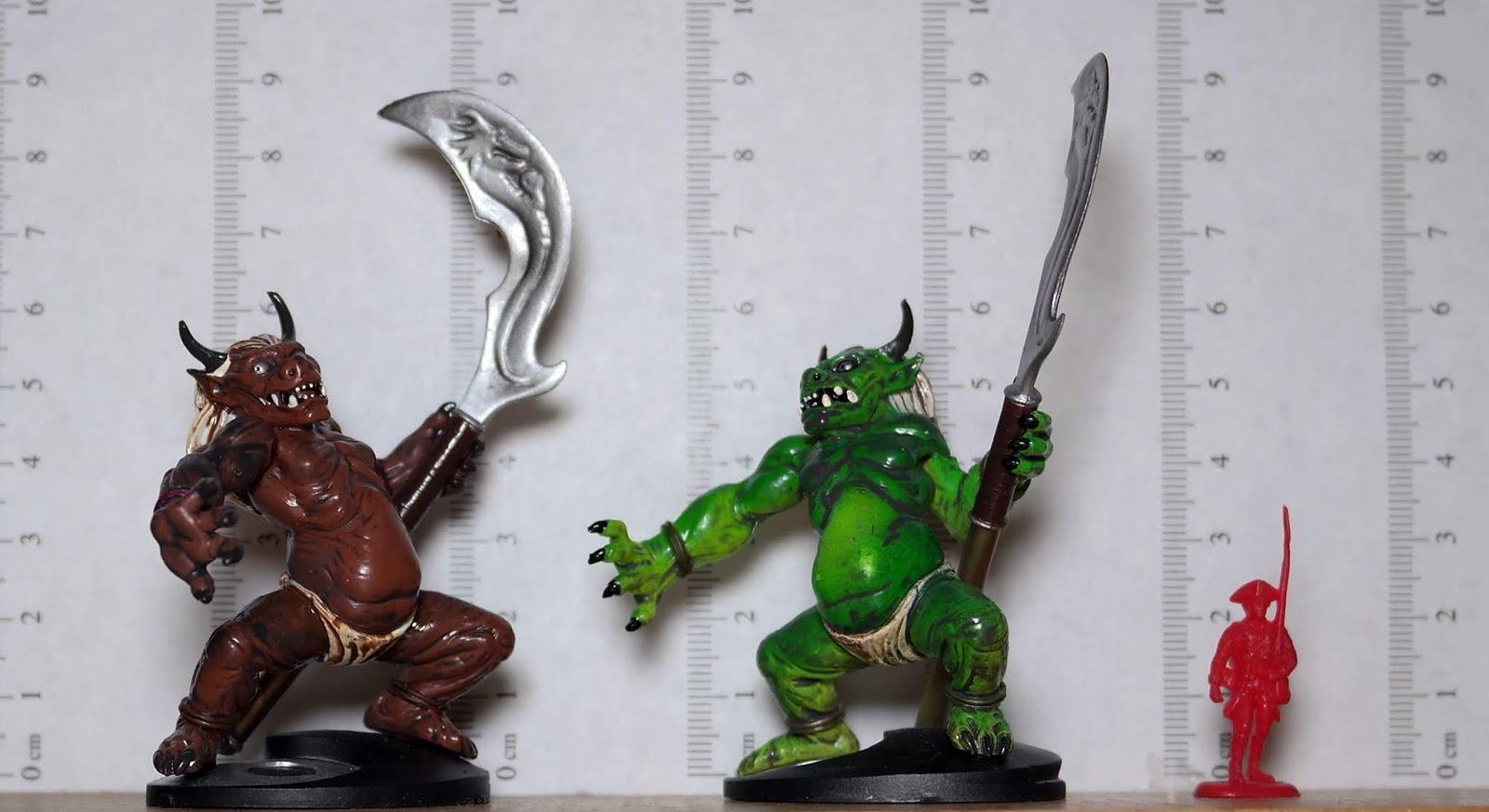
A final comparison shot of the various 15mm oni (and a Daimyo oni).


The 15mm dai oni are just about right for roughly human-sized oni. The others will either need to be converted to increase their height, or used as some other type of small yokai.

In closing, I'd like to mention the Dixon oni from their Legends of Nippon line (which I do not have). The Dixon website never really had any pictures of the oni, so I was hesitant about buying them because I didn't care for the overly thick, chunky style of the Dixon samurai.

However, they recently(?) posted a PDF file with illustrations of their oni and bakemono, which was very encouraging, since the miniatures look pretty faithful to the appearance of traditional oni. I will probably have to order some of these miniatures in the near future.