Saturday, February 18, 2023

Il Gigante

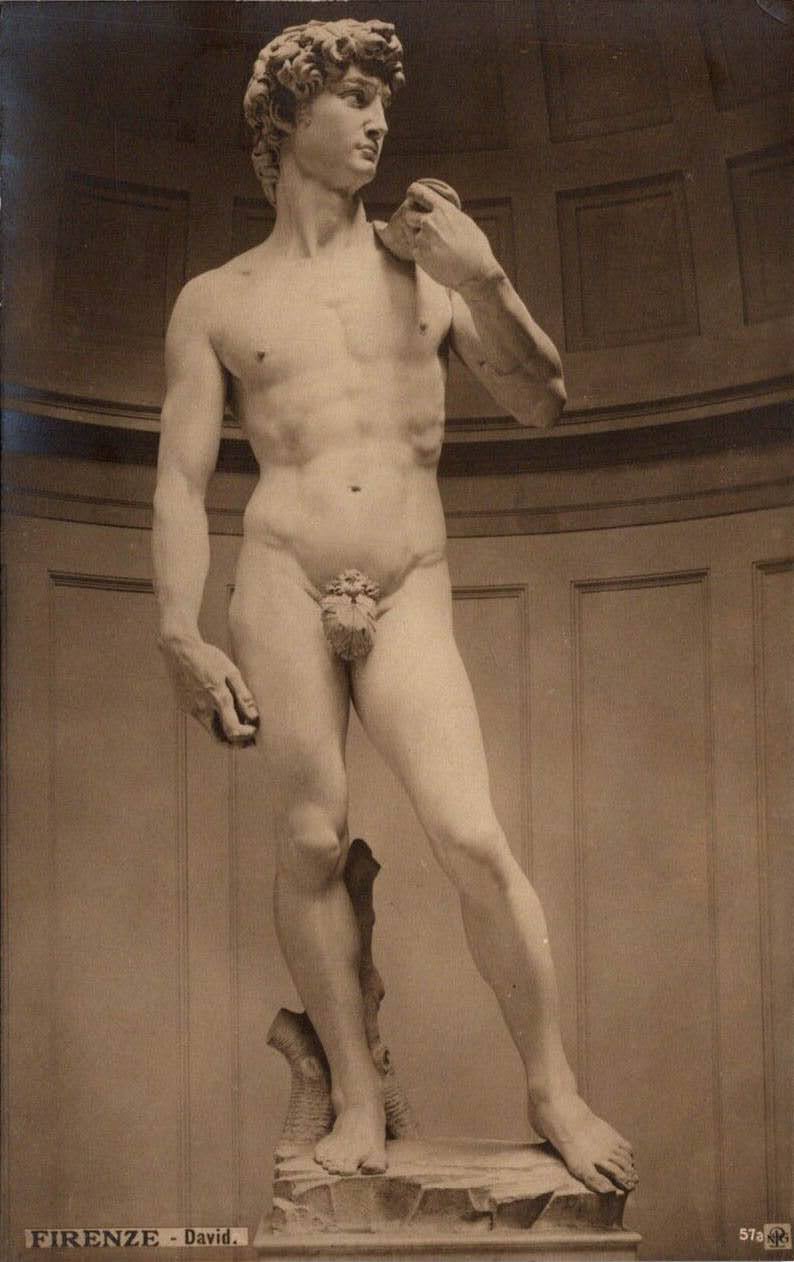
Michelangelo's David has been a subject of controversy over censorship since it's original unveiling in 1504. From my point of view, rhetoric both past and present contain various forms of supposition, bias, and misconception that only serve to muddy the issue.

Galleria dell'Accademia
Not the
Accademia di Belle Arti

Modern sources typically repeat a claim that a girdle of 28 copper leaves was initially used to give the statue some modesty, but according to Franca Falletti in a guest post on the V&A Museum blog, it is not clear whether the "ghirlanda" of leaves was worn around his waist, or as a laurel crown.

Many of these accounts will also state that the "garland" adorned the statue until the mid-16th century, and I find this interesting, because it was around this time that the Council of Trent (1545–1563) proclaimed that religious imagery should not contain elements that they considered profane.

If the garland was indeed draped around the statue's waist, was it merely Florentine contrariness that lead to its removal during this time, or did the powers that be decide to replace the garland with a singular fig leaf?

In any event, a fig leaf was added at some point, and not removed until 1912 according to unconfirmed Internet hearsay (I've also seen c.1890).

From what I can tell, replica statues at the Piazza della Signoria (installed 1910) and the Piazzale Michelangelo (installed 1873) seem to have been displayed in their natural state.

Piazza della Signoria, 1918

Piazzale Michaelangelo
L'Illustrazione Italiana N. 5
4 febbraio 1877

The statue of David that I have is an accessory from an action figure set by NECA for the film The Goonies.


The statue in the film is a small ceramic replica that suffers an unfortunate accident.

That's my mom's most favorite piece!

Exercising their own bit of censorship, NECA produced the figure in its post-accident, pre-repair state.


The real statue stands 17' tall, which means that it should be 71.9mm in 1/72 scale, but the NECA figure is 67.3mm in height, which is a full scale foot shorter.

The math makes the figure out to be around 1/78 scale, but I think it might be closer to 1/76 scale (or somewhere in between) because I feel there is some discrepancy in the height of the base between the real statue and the miniature.

Anyway, the size is a bit off, but the figure is still a usable scenic feature. I'm up in the air about whether to do some sculpting to restore the figure to its intended form.

Michelangelo's Dave


Friday, January 27, 2023

Frogs and Fairies

Ida Rentoul Outhwaite is a 20th C. Australian artist who drew fairies as one of her main subjects. Among her illustrations are many that depict frogs alongside fairies.

I am Kexy, Friend of Fairies.
from The Little Green Road to Fairyland

They Stood in Front of Her.
from Fairyland

A less amicable relationship between frogs and fairies is found in Touhou Project, with the ice fairy Cirno who has the rather cruel hobby of freezing frogs.

The fairy had this to say about
playing by freezing frogs:

Interview from「東方文花帖」

⑨

With the introduction out of the way, I'll segue to the miniatures for this post, which include new grung miniatures and various fairy (pixie) miniatures.

The prepainted grung miniatures are from D&D Icons of the Realms. The Grung Warband (WZK96123) consists of six figures. The first image shows a Blue Grung, an Orange Grung Elite Warrior, a Purple Grung, and a Green Grung.


The second image shows the remaining two members of the warband, a Red Grung Wildling and a Gold Grung Elite Warrior. The final figure is Chief Yorb (Tomb of Annihilation Set 1 #7).


The unpainted Grungs (WZK90415) are from Nolzur's Marvelous Miniatures.


I really like the series of grung miniatures produced for D&D, but the prepainted miniatures are definitely on the expensive side.

For the fairies, I'll start with four figures from Critical Role Miniatures. On the left are three unpainted Wisher Pixies (WZK90558), followed by their prepainted leader, Mystic Iotha (Monsters of Exandria Set 1).


I apologize for the quality of the image, but the clear wings and light primer just made them really hard to photograph.

The assembly of the unpainted miniatures was rather sloppy, with dried glue caking the joins, so a bit of clean up is required before painting. The middle unpainted figure stands higher than the others because I stepped on the figure by accident, breaking it from its base. I reattached the figure by gluing the stand to her coattails instead of her leg, since I felt they should hover near human eye level.

Iotha is painted messily, and looks as if she regularly visits spray tan salons. I don't care for her purple outfit either, so a repaint will be in order.

The next two fairies come from D&D Icons of the Realms. The first figure is a Pixie (Wild Beyond the Witchlight #24), followed by a Healing Spirit (Fey) Spell Effect (Mighty Conjurations #4).


The paint job on the Icons Pixie is better than that of the Critical Role Pixie, but the eyes are out of register, so the face needs touch up.

All of the figures are roughly 13-15mm in height, with wings that resemble those of butterflies.

I'll be looking to see if I can reproduce the wings so I can create additional fairies using some N scale figures that I have as a starting point.


Friday, January 20, 2023

Snowman

Evil snowmen have been a staple of pop culture horror for a long time. Most people are probably familiar with them through the direct-to-video movie Jack Frost, or from Dr. Who, or even from Scooby Doo cartoons.

The Snowmen (2012 Christmas Special)

Scooby-Doo! Haunted Holidays, 2012

A Scooby-Doo! Christmas, 2002

Jack Frost, 1997

One of the earliest depictions of the evil snowman however, is in the cartoon The Snowman from Ted Eshbaugh Studios.


Atlas Obscura hosts an interesting article on the history of snowmen (which may provide some insight to the source of the resentment motivating these snowmen).

I don't think there was ever an official snowman monster in D&D, but a snow golem first appeared in Ship of Horrors for 2nd ed. AD&D.


The 2nd ed. version of the snow golem is described as an 11' tall armored figure sculpted from snow, which seems like something requiring the skills of a trained sculptor to create.

Giorgio Vasari writes in Lives of the Artists
(Le Vite de' più eccellenti pittori, scultori,
ed architettori
) that after an unusual
snowstorm descended upon Florence in
January 1494, Michelangelo was tasked
by Piero de' Medici (his patron) to create
a statue made of snow in the courtyard
of his palace.

By 5th ed. however, artistry seems to have gone by the wayside, and snow golems became crude anthropoid figures.


It is this version of the snow golem, that appears from D&D Icons of the Realms (Snowbound #28), and Nolzur's Marvelous Miniatures (WZK90417).


I don't really care for the use of blue and silver to represent snow on prepainted miniatures, so I will repaint the Icons Snow Golem at a later date.

Some other figures that fit the snowy theme include a couple of chwinga miniatures from D&D Icons of the Realms (Icewind Dale: Rime of the Frostmaiden #3, #16).


One chwinga is throwing a snowball, while the other holds an icicle (or rather, an "icicle staff"). I included a space chwinga from a previous post for comparison purposes.

Last up are a couple of frost salamanders from an older post with a pair of extra arms added on.


For the snow on the bases, I originally wanted to try some of the various commercial products described at Meandering Shade, but for expediency, I went with white glue and baking soda.

Generic brand sodium bicarbonate

Baking soda has small reflective crystals in it, unlike Woodland Scenics Scene-A-Rama Snow which is perfectly matte white, and requires the addition of some embossing powder, or extra fine glitter to give it that sparkly snow look.