Monday, December 10, 2012

Hatsune Miku Jagdtiger

I normally don't have much desire to model late war German armor, but when I first saw pictures of the Miku ita-tank displayed in Volks Hobby Square Osaka, I knew that one day I would have to make my own version in 1/72 scale.


I ended up buying two Trumpeter Jagdtigers (07293 and 07273) for my build because I wanted the Henschel suspension, but not the Zimmerit. Trumpeter does produce a kit of the version I wanted, but because these two kits were on sale, it was actually cheaper to buy two models, as opposed to one.

Below is a picture of the infamous Trumpeter Jagdtiger rear deck with inverted grills, where the fine detail will never be seen again once the hull is closed up.


The instructions say that the tracks can be glued with normal model cement. I found this to be untrue for liquid cement and CA glue, so I used my hot-knife to melt the tracks together.

To create some track sag, I drilled holes through the lower hull and used some pins to depress the track.


If I thought about this earlier, I would have pre-drilled the holes and used a single length of metal across the hull, but because I did it after the wheels and tracks were assembled, the holes were a bit random and I had to adjust the angles of the pins to even out the sag. The pins were later embedded in epoxy to ensure that they wouldn't come loose after I closed up the hull.


Sourcing the decals was the hardest part of this build. The Volks model uses 1/24 decals from Good Smile Racing, but obviously they wouldn't work for my 1/72 tank (not to mention this particular set runs for more than US$100 on the secondary market nowadays). Luckily, I came into possession of a Nendoroid Petit: Vocaloid RQ Set a couple of years back, which included decals that I could use for the tank. Additional decals from Easy Decal were found on eBay.


The decals for the sides were smaller than I would have liked, but they went on easily. The Volks tank bears the number "39" on it in a bit of word play, as the individual numbers can be pronounced "Mi-Ku". I decided to go with "808" in reference to the GSR sponsored BMW Z4 E86s used by Studie for the 2008 and 2009 Super GT seasons. The numbers were from a Fujimi Hetzer kit, but they were pretty old, and fragmented around the edges when I applied them.


The black numbers just looked too plain, so I removed them with some Scotch tape. I'll probably replace them with red numbers with white outlines. The tank still looks a bit underdecorated for an itasha. I'm going to have to look into adding some more bits of art onto it.


Wednesday, December 5, 2012

LVT(A)-1

The LVT(A)-1 is the armored fire support version of the LVT-2 that developed out of lessons learned from the taking of Tarawa. I'm not sure why, but there's something about the sleek boat-like appearance that really appeals to me.

The first 1/72 version to come onto the market was the Altaya diecast model. The Dragon kit came out a bit later, and Hobby Master has recently released a version as well.

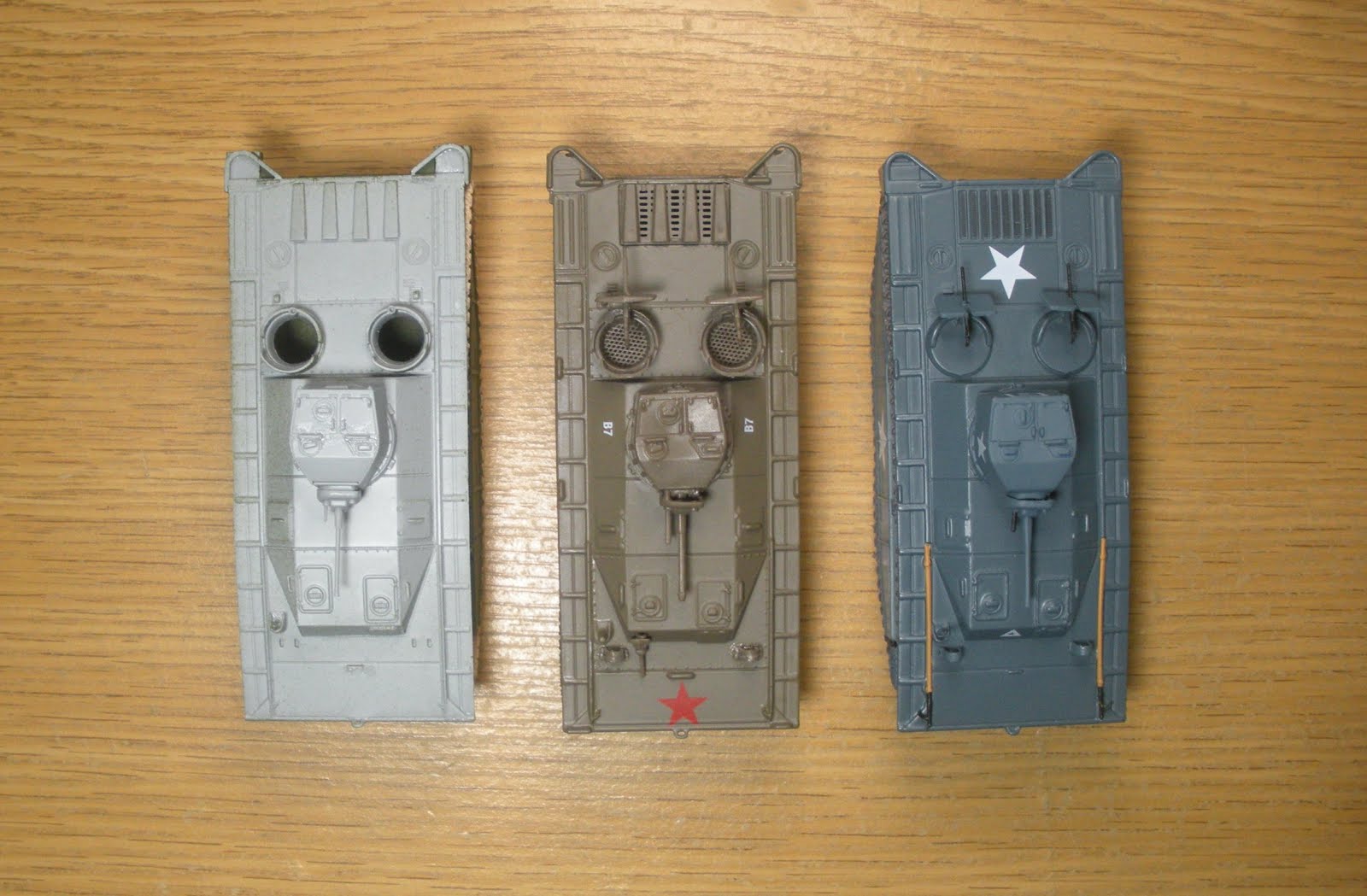
Below are the three LVTs that I currently own. The first one is by Dragon, while the other two are Altaya diecast models. All three are pretty much identical as far as dimensions go, but each model seems to have a different type of engine deck.


The Dragon LVT is very easy to put together. There are a lot of fragile cleats and handholds that can be left off if you want to make it into a more robust wargaming miniature. I'm taking a break in the build because I'm trying to figure out how the gunners were supposed to stand in the gunner's cockpit. Did they just stand on crates or whatever was handy like for the LVT-4, or was there some dedicated platform for them to stand on?


The two Altaya LVTs are completely different molds. The olive colored one is the older version, and the navy gray one is the newer version. Both have diecast upper hulls with the remaining parts in various types of plastic. The most obvious differences are that the older version has a front hull machine gun, and mesh grill floors in the gunner's cockpits (though they are not deep enough to accommodate a standing gunner). The newer version just seals over the gunner's cockpit entirely, and is missing the armored backrest. The 37mm gun differs between the two models as well.


The olive LVT represents a USMC vehicle used at Peleliu. The lettering scrawled on the side of the model is way oversized. In addition, the stars on the LVT are red. Makes me really wonder if this is a real Altaya LVT. I've seen similar models being sold from eastern Europe on eBay, so maybe not...

The LVT also seemed to have the tracks on in the wrong orientation. I was considering leaving them as they were, but because other Altaya tracks came off so easily, I succumbed to the compulsion to turn them around. Big mistake. The interior halves of the return idlers crumbled immediately, with one drive sprocket suffering a similar fate.


I managed to repair the drive sprocket, but could not do anything about the inner half of the idlers. I've only seen really old Airfix figures disintegrate like this, and it makes me very nervous about how all of my models are going to hold out over time.

Monday, December 3, 2012

Halo Micro Ops Vehicles


I'm using this post to finish up my review of the Halo Micro Ops Series 1 USNC figures and vehicles that I started back in September. I can't say that I care much for the designs of the figures or vehicles of the Covenant side, so I'm going to ignore them.

First up are the figures, consisting of Sgt. Buck (the tallest figure from the ODST Drop Pods set from my September post), followed by Emile-A239 from the Ghost vs. Wolf Spider set; an anonymous marine and an anonymous Spartan from the High Ground Bunker set; and Carter-A259 and an anonymous kneeling marine from the Falcon set.


It seems to me that most of the new figures are bulkier than Sgt. Buck. They may not necessarily appear any taller in the picture due to their crouching poses, but I think the they are much closer to 1/72 figures than the figures from the ODST Drop Pods set.

Onto the vehicles:


The UH-144S Falcon is easily my most favorite vehicle of this series. It scales out exactly to 1/76 according to the dimensions given for it. The rotors tilt, the cockpit canopy can be opened up, and there are several points of articulation for the door guns.


Unfortunately, the set does not include any door gunners, however, the pilot figure is suitable for use in this role. It also happens to be the same figure that is used as the driver for the Warthog, so I bought two of the Warthog & Mongoose sets to get a pair of door gunners.


The two vehicles that come in the Warthog & Mongoose set are the M12 Force Application Vehicle, and the M274 Ultra-Light All-Terrain Vehicle. According to the vehicle specifications, the Warthog is 1/72 in width, but 1/78 in length. Even so, to my eye it is just looks too big.


Art for the Warthog is not consistent with regard to its size, and the best representations (to me) show the vehicle as being roughly the size of a HMMWV.


Dimensions for the Mongoose are not given, and artwork shows the vehicle ranging anywhere from the size of a standard ATV to the size of the Peugeot Quark that was displayed at the 2004 Paris Motor Show.


The mass of the Mongoose is listed as 406 kg which is somewhat less than that of the Quark, so I would hazard that the vehicle is roughly the same size as the Quark. With this interpretation, I would say that the model is not too far off from 1/72.

Halo vehicle comparison with a diecast HMMWV (CDC Armour 3117).


Note: I didn't mention much about the High Ground Bunker set, but more details can be found at HaloFanForLife.