Showing posts with label irregular. Show all posts

Saturday, December 14, 2013

More Hobbits


Tolkien writes that hobbits are between two and four feet in height, a fact that is echoed in this Warner infographic. But then, counter to depicting Bilbo as an everyman hobbit, Peter Jackson makes him a heroic 4' 2", almost as tall as his legendary great granduncle Bandobras Took.

I believe that most sources however, would agree that Bilbo was just average height at best.

WARNING! Not suitable for all audiences.


The hobbits from the Lord of the Rings HeroClix CMG are about two-thirds the height of a human-sized HeroClix. They can't be used as hobbits in 1/72 scale, but they are perfect as normal humans.


For miniatures that are more suitable as hobbits, we have to the left, four halflings from the Ral Partha Fantasy Collector Series. These are all taller hobbits that can be used to represent Fallohides. To the right is a Heritage hobbit from the Little People set (Fantasy 1311), and the R-Kiiv Merry Hibbot now produced by Center Stage Miniatures as a Halfling Adventurer (FEP-003).


The R-Kiiv Hibbot reminds me of the Ducreux self portrait used for the Archaic Rap meme, and seems even more appropriate given that he seems to hold a sack of coins in his hand.

Unfortunately, this is the best I could do...

Smaller hobbits include the Essex 15mm halflings, which seem to be scaled down versions of their 25mm line. To me they seem to be a bit undernourished, and don't quite have that chubby look that I like to see in a hobbit.


Last are some Irregular halfings. I know that I made fun of their 10mm halflings, but the 15mm halflings are actually quite nice. They are a bit on the short side, but are nicely rounded as hobbits should be.


I now have more hobbits than I know what to do with...

(Or try this link if you cannot access the video.)


Wednesday, April 11, 2012

Intulo


Intulo by Deviant artist Slaskia

While looking for information on lizardmen in mythology, I came across the Intulo of Xhosa and Zulu folklore. It is vaguely described as a "lizard-like creature with human characteristics". In other instances, it is described as a blue-headed lizard or gecko.

In Zulu mythology, Unkulunkulu (who is described by various authorities as either a sky-god or an ancestral spirit) sent Unwaba the Chameleon to bear the message of immortality to men. However, after the chameleon set out, Unkulunkulu had second thoughts about granting immortality to men. He sent Intulo the Gecko after the chameleon to proclaim that men would be mortal. Intulo was much faster than the chameleon, and delivered his message to man long before the chameleon arrived. Thus, both creatures are viewed as harbingers of doom by the Zulu people.*


The only other mention of the Intulo I could find was in Final Fantasy XI, where they are reptilian creatures that spit poison, and have strong resistance to all magic except fire.


Now, there is no Intulo miniature of any type that I am aware of, but when I saw the lizardmen from Irregular Miniatures, the first thing that came to mind was that they were Intulo. Why? I don't know, but perhaps it was because of their big bulging eyes. From left to right, the figures are Heavy Infantry Lizardman with Halberd (FLM5), Lizardman Standard Bearer (FLM8), Lizardman Drummer (FLM9), and Lizardman Swordsman (FLM1).The fifth figure is the Lizardman Chief (FLM10), but it is of completely different appearance to the rank and file, and looks a heck of a lot like Prickle from The Gumby Show.


I couldn't find an actual South African creature that was said to be the blue-headed gecko of myth, so I patterned my paint scheme somewhat after Bibron's Gecko (of the genus Pachydactylus), and the Blue Headed Tree Agama, both of which are common to that region.


The paint-job looks a little meh at the moment, but I think a coat of satin lacquer and a dark wash would probably do wonders for it.

If you wanted to cast the chameleon as the Intulo (or just as plain Unwaba), there are the Warhammer Fantasy Chameleon Skinks (GW 88-47). The first figure is actually the Chameleon Stalker, but it sometimes replaces one of the standard figures in the normal blister of Chameleon Skinks.


* Note: In The Religious System of the Amazulu, the two creatures are called Intulo and Abantu. Henry Callaway translates "intulo" as chameleon, and "abantu" as lizard (in the role of the gecko).


Saturday, October 15, 2011

GNU


The gnu is an African antelope, bulky but compact.

The gnu (or wildebeest), is an antelope that is the source of a number of monsters from the AD&D Monster Manual.

A. The gnu appears as its normal, everyday self under the entry of Herd Animal.


The only gnu in 25mm comes from the Veldt Animals set (Ral Partha 31-032). The miniatures are still available from Ral Partha Europe, and at one time, you could order single castings of the animals, but that may not be an option any more.


A Herd of One

B. The D&D catoblepas can trace its origin to Pliny, and it is now believed to have been derived from second-hand accounts of the gnu.

"...with a very heavy head which it carries with difficulty and it always hanging down to the ground. Otherwise it is deadly to humans, as all who see its eyes expire immediately."

Natural History


The only miniature of the catoblepas is from the Ral Partha AD&D line, but it is entirely too big (IMO), because the catoblepas is described as being the size of a bull.


However, I stumbled upon some Ral Partha Skull Pigs for Werewolf: The Apocalypse (Ral Partha 69-025), which I thought would make a good start as the basis to create a figure modeled after Trampier's catoblepas from the Monster Manual.


The Skull Pigs are roughly the size of a gnu, and the miniatures come in two poses, each composed of four pieces (body, head, and two tusks).


So far, I have drilled some holes in the neck of one of the Skull Pigs, and glued several pieces of floral wire in the holes.


I then bent the wires to form the neck.


J-B STIK was used to firm up the connection between the body and the wire neck, and a paper clip tail was glued in place.


The next step will be to modify the head, but just as a preview, I used some Elmer's-Tack to attach the Skull Pig head to the rest of the body.


Sculpting the head will be the hardest part, but hopefully I'll be able to get some time to work on this during the upcoming holidays.

C. The D&D gorgon is the final creature that originates from the gnu. Essentially it merges elements of Aelianus' decription of the catoblepas with elements of Phalaris' brazen bull.

"...it feeds upon poisonous roots. When it glares like a bull it immediately shudders and raises its mane, and when this has risen erect and the lips about its mouth are bared, it emits from its throat pungent and foul-smelling breath, so that the whole air overhead is infected, and any animals that approach and inhale it are grievously afflicted, lose their voice, and are seized with fatal convulsions."

On Animals


Two suitable old school gorgons for 25mm are the Ral Partha Gorgonian Brass Bull (02-410) and the Grenadier Iron Bull (Monster Manuscripts MM38). The brass bull has a mix of plates and scales, while the iron bull is completely covered in plates. Both miniatures are nice, but I'd like to get a model completely covered in scales like in the picture above. Reaper makes a miniature similar to this, but it is probably twice the size of either of my current gorgons, so it's way too big.


D. And lastly, so as not to seem biased towards the gnu, I present the yak.


When overloaded or exhausted, the yak will lie down,
hiss, spit and kick, and refuse to move.

I know of three companies that make yak miniatures. Two of these companies' yaks are 28mm, and the third is listed as 25/28mm. Taking a chance that their yak would not be too big, I ordered the 25/28mm yak from Irregular Miniatures (AN22).


Unfortunately, the Irregular yak is too big to use as a typical domestic yak (probably 1.6m or less at the shoulder). There are said to be wild yaks that are over 2m at the shoulder, so I suppose that the Irregular yak can be used as one of those.


Friday, September 30, 2011

My Little Pony


Closing out my recent string of posts on whimsical miniatures, I present models that can be used as magical ponies.


The first miniature comes from the Reaper Evil Toys blister (02887). It is of typical Little Pony proportions, with thick legs and tattooed backside. The second miniature is a 15mm Irregular horse (FAN14). This is the basic miniature that I will be using for my magic pony conversions. Last are a unicorn, and winged horse from the Reaper Foals blister (02207). These two miniatures were sculpted by Rene Perez, which leads me to believe that they were originally 15mm figures intended for the Shadow Corp line.

The ponies range in size from 8 to 11 hands high, and are suitable for adult Little Ponies. Irregular has 10mm horses as well, so I'll probably have to order some in the future to create baby Little Ponies.

I also have some plastic "alicorns" that came from a 1/72 medieval playset. The ones in my set were made in purple, and a fluorescent orange plastic. The orange one is almost impossible to photograph, so I'm not showing it in this picture. They stand at 12 hands high.


Here is my first pony conversion. I gave it a Kneadatite weave, and fixed up the right side of its head a bit. Even after lengthening the mane, the miniature looks rather subdued as far as magical ponies go. I may have to work on introducing a bit of that poofy glam rock hairstyle look for my next ponies.


When I first painted up the pony, it had a white mane, and was almost physically painful to look at. I changed the color of the mane to lavender, so it would be a little easier on the eyes.


In closing, for those of you who remain skeptical about using ponies in dungeoncrawls or for wargaming, allow me to present evidence that even Wolverine is down with My Little Pony.


Saturday, March 12, 2011

Every man his own horse


The centaur is one of the classical beasts of Greek mythology. In ancient art, they are often depicted as being about the same height as men, but modern art shows them as being much larger than men. Certainly the description of centaurs using tree trunks and boulders as weapons in their battle with the Lapiths points to a larger stature.


The centaur also appears in Sumerian art, though I am unaware of any stories about centaurs in their mythology.


Some of the earliest depictions of centaurs in Greek art showed them as essentially fully human from the front, with the hindquarters of a horse attached to their back.


As a civilized centaur, Chiron is shown wearing a chiton, but the typical barbarous centaur went unclothed.


They are also sometimes portrayed with pointy ears, though not very frequently.

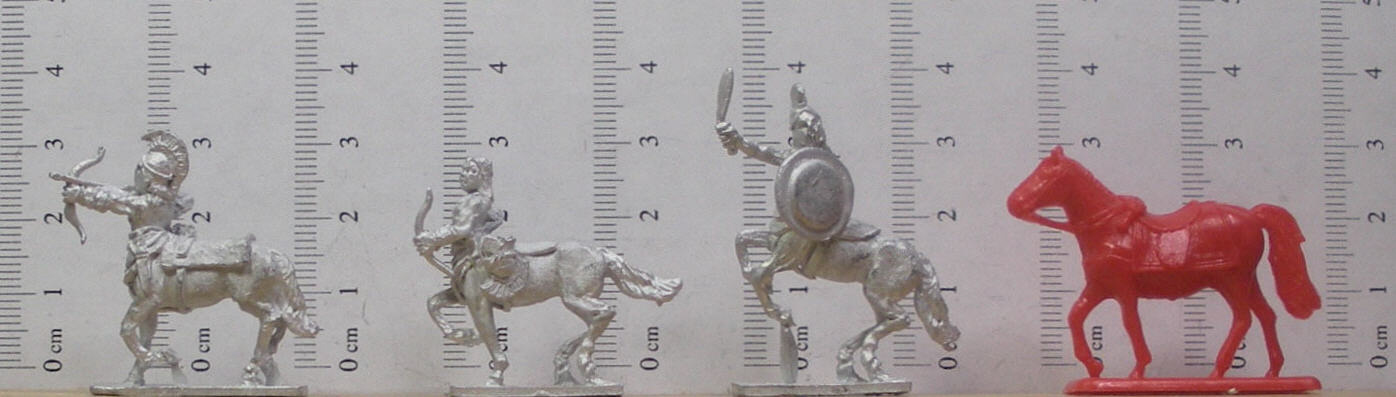
I wasn't sure about the best way to present my centaur miniatures, so I grouped them by manufacturer, and followed up with various size comparison pictures. The horse used in the comparisons is roughly 15 hands high in 1/72 scale.

The first group of centaurs are from the Ral Partha Personalities and Things that go Bump in the Night line. They consist of the Centaur Archer (Ral Partha 01-032) Centaur with Spear v3 and v2 (Ral Partha 01-032) respectively. These are classical centaurs, and scale out to about 14 hands high.


In the next picture are the Armored Centaur (Ral Partha 01-047), and male centaur from the Centaurs (male and female) set (Ral Partha 02-903). The Armored Centaur is a typical modern fantasy centaur, and stands at about 17 hands high. The other centaur is a classical pastoral centaur, standing at 14 hands high.


The final group of Ral Partha centaurs consist of Centaur Adventurers (Ral Partha 02-968), and a Centaur with Sword and Shield (DF-033). All of these centaurs are 14-15 hands high.


The next image is of two Grenadier centaurs - an Armored Centaur (Fantasy Lords 134), and a Female Centaur (Fantasy Lords 064). Both are roughly 17 hands high.


This next pair below, are a Heritage centaur (Fantasy 1328) which stands at 14 hands high, and a Lance and Laser Armored Centaur which stands at 17 hands high.


Below, are three centaurides consisting of Sagittarius (Reaper 03376), Lamia from the Heritage miniatures Manticore and Lamia set (1298), and Lyria Female Centaur (Dark Sword Miniatures 1105). The Reaper centaur is very small at 13 hands, while the Lamia is 16 hands. Both have disproportionately large human torsos. The Dark Sword centaur on the other hand, is almost 20 hands high, and has a disproportionately small human torso.


The next set of images are of Mega Miniatures centaurs formerly produced by Metal Magic. These centaurs stand 16 hands high, and look to be compatible with 25mm or 28mm figures.


A couple of centaurs from Mage Knight appear in the next image. The enormous Centaur Shaman stands 19+ hands high, while the strangely proportioned Centaur Archer is 11 hands high. Its forelegs appear to be twice as long as its hindlegs. It also seems to be wearing leg warmers (?!?!!).


Next are the 15mm centaurs from Eureka, which stand at just over 12.5 hands high.


Two more centaurs from Eureka, and an Irregular centaur standing at 12 hands high.


Comparison between man, horse, and 28mm centaurs:


28mm centaurs just seem too big to use in 1/72 scale fantasy to me. Maybe one or two giant centaurs could exist, but I wouldn't use too many of them.

Comparison between man, horse, and 25mm centaurs:


My preference for use in 1/72 scale fantasy are 25mm centaurs. Averaging at 14-15 hands high, they are large and imposing, but not freakishly large. I like the old Ral Partha centaurs the best, because they have the wild and untamed appearance that I associate with centaurs.

Comparison between man, horse, and 15mm centaurs:


If one were to go by Greek vase paintings, 15mm centaurs would be the best match with 1/72 figures. At 12 hands high, they would be pony sized, but there are sources that say horses during ancient times were typically pony sized (or slightly larger).

28mm+ centaurs


28mm centaurs


25mm galloping centaurs


25mm centaur archers


Various small centaur archers


15mm centaur archers


Rearing centaurs