
The ogre mage or Japanese ogre of D&D is essentially an oni (which I guess has been the official designation since 4th edition).
 |
| Fuji Musume + Oni no Nenbutsu by Kitagawa Utamaro |
The typical oni that an adventurer might meet would be something like the ogre or giant of European mythology, but oni are also servitors in the Buddhist hells, and in this role bear many similarities to Abrahamic devils.

In art, they are portrayed anywhere from being slightly larger than a human to being gigantic in size. Most miniatures will tend to be of the later type when used with 1/72 scale figures.
I will start by showing some of the shokugan/gashapon figures that I own. The standing pair are from series 1 of the Collect Club Seven Wonders Compilation (コレクト倶楽部 七不思議編) released by UHA Mikakuto (UHA味覚糖), and are a red oni (赤鬼) and blue oni (青鬼) respectively. The crouching figure is the red (赤) version of a yōkai netsuke (妖怪根付) from the Hyakki Yagyō Yōkai Collection (百鬼夜行妖怪コレクション) released by Furuta (フルタ).

The series 1 UHA figures are single piece castings made of a dense polystone resin. The Furuta figure is made of PVC, and a painted version is also available.
 |
| 鬼 (赤) | 鬼 (天然色) |
The subsequent series 2 figures from UHA are a black oni (黒鬼) and a green oni (緑鬼) respectively.
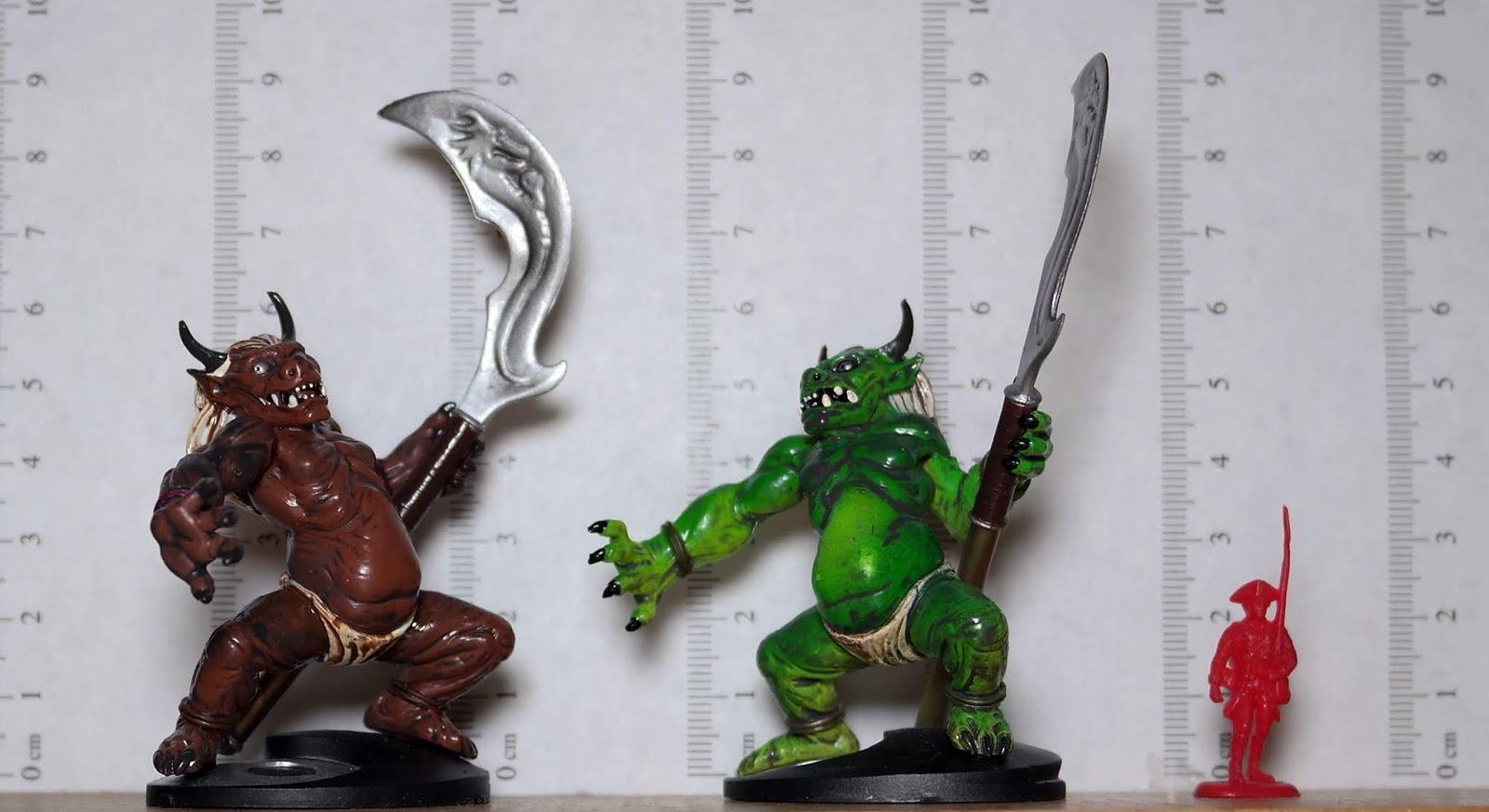
The series 2 figures are multi-part PVC, and require some assembly.

The next figures come from the Rising Sun boardgame produduced by CMON. They include the Oni of Plagues, a Turtle Clan Shinto, and two Turtle Clan Bushi.

I'm not enthusiastic about the fancifully ornate weapons of the Oni of Plagues, but I liked the figure because it reminded me of Tsuchigumo from Nurarihyon no Mago. As for the Turtle Clan miniatures, I don't think they are actually supposed to be oni, but they are horned and fanged, so look close enough to be oni for me.
I particularly like that the monk on the Shinto figure is close in size to the similarly posed figure from the Arcane Legions game. However, I find the use of the term "shinto" for this class of characters by the game writers odd, and I'm thinking the word they should have used would be kannushi (but what do I know).

In the next image, we have the Oni of Blood which is also from the Rising Sun game, while next to it is a DDM Oni Night Haunter (Lords of Madness #35).

The Oni of Blood is a very elaborate sculpt, and I'd be really interested in seeing the production mold for it because it seems to have been made as a single piece.
I did a quick earthen wash over the pants of the Oni Night Haunter because I didn't like the original bright yellow color. The base was also replaced with a metal washer because it was so warped that I could not flatten it out using either hot water or a blow dryer.

The next two figures are the D&D Miniatures Icons of the Realms Ogre Mage (Classic Creatures #5), and a Reaper Female Oni (Bones 77486).

I like this CMG ogre mage because it has a single horn, which is sorely underrepresented in miniature oni. The turquoise and magenta skin of these two oni go well together, and are a nice variation on the traditional blue and red oni.
The next section covers all of my metal oni. The first three miniatures are a Ral Partha Ogre Mage (AD&D Monsters 11-405), a Ral Partha Dai-Oni (Bushido 53-912), and a Ral Partha Japanese Ogre (Children of the Night 13-039).

The last two figures are supposed to be armed with naginata, but I seem to have lost the weapons at some point.
The next image has an armed pair of Ral Partha Oni (Bushido 53-908), a Ral Partha Dai-Bakemono (Bushido 53-911), and an Asgard Oriental Ogre (Fantasy Monsters FM22).

The dai-bakemono is supposed to have a large tetsubo, but again, I seem to have lost the weapon. The Asgard miniature is the earlier version of their oriental ogre. It was probably originally holding some sort of weapon, but I'm not sure what type it was (the later resculpted version of this miniature carries a large two-handed mace).
The next image shows some old Reaper miniatures. The larger figure is a Bakemono (Daimyo 4027), while the three smaller ones are Oni (Daimyo 4028). The Daimyo Oni are sized like 15mm figures, and I get the feeling that they were originally supposed to be "oriental goblins". Certainly when these miniatures were first released by Texas Miniatures, they seem to have all been called bakemono, so they didn't start out as oni.

In any event, I'm grouping all the creatures called bakemono with oni because they look close enough going by looks alone. My understanding of the word "bakemono" is that it is a generic term like "monster", so using the word to indicate a specific type of creature is vague and confusing (I blame the Bushido RPG for this).
Along those lines, I'm counting the Grenadier Oriental Goblins (Fantasy Lords 184) shown in the next image among my ranks of oni.

Even so, these goblins don't have features that are particularly oni-like, and wear their hair in a chonmage, so I'll probably need to do a little modification to turn them into proper oni.
In the Legend of the Five Rings RPG, it seems that oni are called ogres, while demons are called oni. This is reflected in the AEG Clan War miniatures, with the Ogre Bushi (Shadowlands 13-103) looking like an oni, and the oni lord Kyoso no Oni (Shadowlands 99-002) looking like a demon.

The Lesser Oni (Shadowlands 13-113) are also very demonic, and look nothing like traditional oni at all. In fact, I would probably classify them as generic bakemono.

The final section covers 15mm oni from Alternative Armies, and Battle Valor Games.
The Alternative Armies figures are part of their Sengoku Japanese Fantasy line. In the first image (from left to right) – Oni with Claws (SGF04), Oni with Large Blade (SGF05), Oni with Large Blade (SGF06), Armoured Oni with Large Blade (SGF85), Armoured Oni with Claws (SGF86).

More Alternative Armies figures (from left to right) – Oni with Claws (SGF87), Oni Shamen [sic] (SGF88), Oni with Tetsubo (SGF89), Oni with Tetsubo Beckoning (SGF90)

The armored oni are human-sized, while the unarmored oni are shorter. I wish the unarmored oni had been made the same height as the armored ones.
The Battle Valor oni are figures from the Samurai fantasy skirmish Kickstarter by Philip Mann. I pledged at the Oni Lord level to get an Oni Army Set.
The first image is of the Oni Command (SAM126).

Next are the Dai Oni (SAM127).

Then the Oni (SAM128).

Last are the Small Oni (SAM129).

There are a lot of similar poses between the oni and dai oni, but the later are more suitable as 1/72 oni. I don't see the oni on the Battle Valor website at this time, but I imagine they will appear at some point in the future. Hopefully the Dai Oni Command set which was not unlocked during the Kickstarter campaign will be produced as well.
A final comparison shot of the various 15mm oni (and a Daimyo oni).

The 15mm dai oni are just about right for roughly human-sized oni. The others will either need to be converted to increase their height, or used as some other type of small yokai.
In closing, I'd like to mention the Dixon oni from their Legends of Nippon line (which I do not have). The Dixon website never really had any pictures of the oni, so I was hesitant about buying them because I didn't care for the overly thick, chunky style of the Dixon samurai.
However, they recently(?) posted a PDF file with illustrations of their oni and bakemono, which was very encouraging, since the miniatures look pretty faithful to the appearance of traditional oni. I will probably have to order some of these miniatures in the near future.


.JPG)


